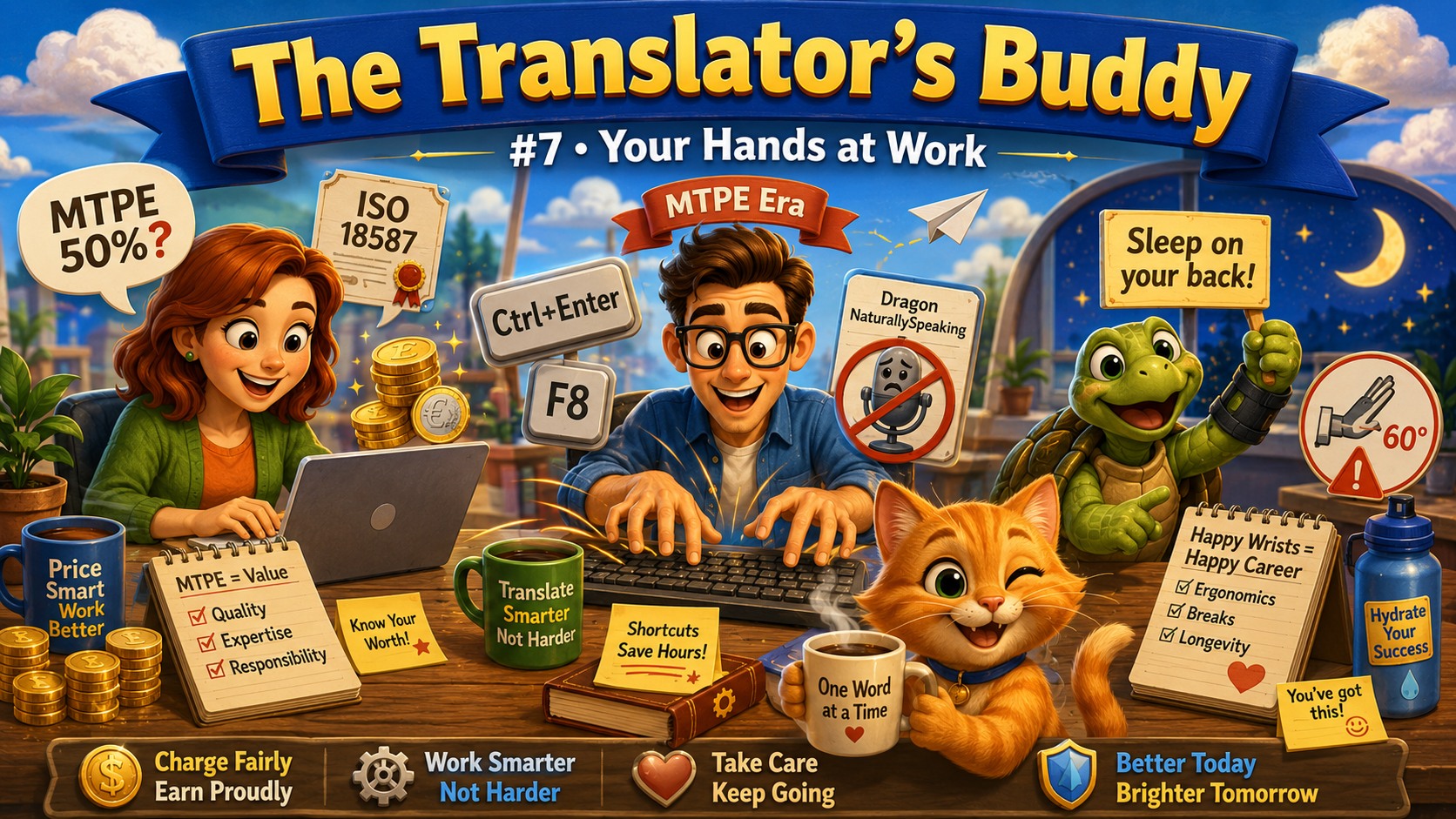
Issue #7 of The Translator’s Buddy
Issue #7 of The Translator’s Buddy — published Tuesday, 27 May 2026. Reading time: 11 minutes.
Your Hands at Work
Look at your hands.
Right now, on the keyboard or holding the phone. They are the most expensive tools in your business, and the only ones you can’t replace.
This issue is about three things your hands do every working day. The money they earn, and where some of it quietly disappears. The words they type, and how that work has changed more than most translators realize. And the silent damage they take while doing both.
Coffee ready. Let’s go.
🤝 The MTPE Math Agencies Hide from You
The most uncomfortable math in your translator career is the math you’re about to do.
Take your last three MTPE projects, open a spreadsheet, and lay out three columns: words, hours, total paid. Now divide. If your effective hourly rate dropped below what you charge for human translation, you’re paying the machine to do your job.
Today we fix that.
The Lie
The standard agency pitch goes like this: “We use machine translation, so we need a 50% discount.” It sounds reasonable. The machine did half the work, you do half the work, you get half the money.
Americans famously don’t discuss money or politics in polite company. Trump aside, want to peek over your colleagues’ shoulders for a minute?
A 2025 survey by GTS Translation Services of 212 freelance translators turned up a number almost nobody talks about. Roughly half of the respondents offer no MTPE discount at all: none, zero, same rate as human translation. Among those who do discount, the most common range is 10 to 30 percent. Not 50.
Read that again. Half the profession is charging the regular rate.
Write the math down and it gets brutal. If your normal rate is €0.10 per word and you accept MTPE at €0.05, you now need to process exactly twice as many words per hour to earn the same money. Not a bit faster. Not “it feels easier.” Twice as fast.
So the question is simple: does MTPE really make you twice as fast?
The cleanest public benchmark comes from the European Union’s Translation Centre in Luxembourg. Their contractor expectations: ten pages a day for translation, fifteen for full post-editing, twenty for light post-editing. That makes Full PE roughly 1.5× faster than translation, not 2×.
In practice, a 50% discount only breaks even on Light PE — and only if the MT output is clean, the terminology is under control, and there’s almost no hidden QA, research, or client-question time eating your day.
Independent academic data tells the same story. Sanchez-Torron and Koehn at the University of Edinburgh ran the most-cited study in 2016: ten professional translators, same source text. Average MTPE productivity gain: 24%. One translator was actually slower than translating from scratch. The fastest in the group came in at 56%.
So when an agency says “50% off for MTPE,” they’re quoting their best case as your average. That isn’t pricing. That’s negotiation. And if MTPE makes you 40% faster but you accept a 50% discount, that isn’t efficiency. It’s a pay cut with better branding.
Your Defensive Weapon
In 2017, an international standard quietly entered our world: ISO 18587. Translation services. Post-editing of machine translation output. Most translators have never read it, and agencies count on that.
The standard makes one distinction that protects you in every MTPE pricing conversation: full post-editing versus light post-editing.
Full post-editing is defined as output “comparable to a product obtained by human translation.” Same grammar, same syntax, same accuracy, same liability. In other words: a Full PE deliverable IS human translation. You’re liable for it, you signed off on it, and the agency can’t tell their client “well, the machine did it” if something goes wrong.
Jakub Absolon, who runs ASAP-translation in Bratislava, put it cleanly on the Slator Pod: full post-editing is simply human translation and should be priced and timed as such.
Light post-editing is the other thing. The standard describes its output as “merely comprehensible”: no claim of fluency, no claim of accuracy, internal use only, gisting.
Two different services. Two different prices. Two different liabilities. Agencies often quote “MTPE rate” without saying which, so you have to ask. And once you ask, the conversation changes.
Tip for the agency owners reading this: raising your MTPE rates by a couple of cents per word is the simplest retention strategy available in 2026. The translators worth keeping are already running the numbers above. Happy translators stick around. Underpaid ones quietly disappear.
The Walk-Away Math
One number decides whether an MTPE project is worth your time: edit distance.
If you have to change more than 35% of the machine output, you’re doing a human translation with extra reading work on top. Industry guidance from TAUS in Amsterdam puts the threshold at 25% for high-impact content and 35% for low-impact. Translation: if the MT output is bad, MTPE is slower than starting fresh. The agency saves money, you lose money.
Before accepting any MTPE project at a discount, ask the agency for a 300-word sample of the raw MT output. If the sample looks rough, you have two moves. Ask for the full per-word rate and frame it through ISO 18587: this is Full PE, which the standard defines as equivalent to human translation. Or decline.
A failed negotiation isn’t a disaster. It’s information. The agency now knows your floor, and the next time they have a clean MT project at fair rates, they’ll remember.
Action Today
Stop pricing MTPE as “translation rate minus 50%.” Price it backwards instead: target hourly income divided by real MTPE productivity. That’s your floor.
Four steps, in this order.
One. Pull up your last three MTPE invoices. Divide payment by hours and get your effective hourly rate. Compare it to your human-translation hourly rate. The gap is the data you’ve been missing. (TO3000 users already see this kind of breakdown in their per-client reports automatically. For everyone else, a spreadsheet works fine tonight.)
Two. Read the ISO 18587 summary. Fifteen minutes. Save the link, cite it next time an agency quotes “MTPE rate” without saying which tier.
Three. Save this template line and use it instead of arguing:
“My MTPE rate depends on raw MT quality and required final quality. I can confirm the final rate after reviewing a short sample of 300 to 500 words.”
That one sentence is harder to argue with than any specific number. It forces the agency to show you the MT before you commit to a discount. Calm, professional, quality-first.
Four. The next MTPE quote you get, ask three questions. Light PE or Full PE? Can I see a 300-word sample of the raw MT? What’s the edit-distance discount structure?
The agencies that answer all three are the ones worth keeping. The agencies that hang up were never worth keeping in the first place.
⚡ Typing in the MTPE Era
Twenty years ago, the fastest translators talked. They sat with headphones, read the source from a paper printout, and spoke the target into Dragon NaturallySpeaking at 150 words per minute. Three times faster than typing.
That world is mostly gone, and the bottleneck moved. Today it isn’t your speaking speed, and it isn’t even your typing speed. It’s something almost nobody trains for.
A Note on Dragon
Remember translators producing 8,000 words a day by dictating? That workflow has been quietly retired. Dragon NaturallySpeaking became Dragon Professional Individual, then v16 in 2023, and no version has shipped since. Microsoft bought Nuance in 2022 for $19.7 billion and pointed the product at hospitals. The Mac version was discontinued back in 2018.
If you still dictate, Dragon v16 works on Windows for $699. If you’re starting fresh in 2026, Whisper-based tools like MacWhisper handle 90% of what you actually need for $59 — or free.
But voice isn’t really the bottleneck anymore.
The New Bottleneck
MTPE changed the shape of the work. You no longer write paragraphs. You read pre-translated segments and decide — accept, fix, rewrite. If you fix, you click into a specific word, change it, confirm, and move to the next segment.
Talking to your computer to fix one word in the middle of a sentence is slower than just clicking and typing. So voice died. Here’s what most translators miss, though: linear typing also plays a smaller role now.
In a full-translation workflow, typing speed determined output. In MTPE, output depends on three other things: how fast you read the segment, how fast you decide what to fix, and how fast your cursor gets to the fix.
That last one, cursor navigation, is where modern translators lose hours every week.
The Shortcuts That Matter
The fastest MTPE translators don’t type faster than the slow ones. They navigate faster.
The skill you want is keyboard mastery of your CAT tool. Not Trados certification, not a course. Just the dozen shortcuts that come up every minute.

Print the dozen shortcuts for your CAT tool on one sheet of paper and tape it next to your monitor. After two weeks you won’t need the paper. That’s the entire training.
The Free Tools That Still Help
For the part of your day that’s still raw typing (direct clients, transcreation, subtitling, literary work), typing speed still matters. That’s about 30% of the modern translator market.
Free tools that work in 2026.
Monkeytype.com. Five minutes a day, tracks wpm and accuracy. Keybr.com runs adaptive practice that focuses on your weakest letters. TypingClub.com gives you a structured curriculum if you never learned touch typing properly.
Espanso is the one to actually install. It’s an open-source text expansion tool by Federico Terzi out of Bologna. You type ;sig and your signature appears. You type ;inv and your invoice email template appears. Free, cross-platform, works on every operating system.
This last one saves more time than any typing speed gain ever will.
Going from 50 to 70 words per minute is achievable — eight to ten hours of practice for a modest income gain. Setting up Espanso properly takes about two hours of work and gives you a bigger, permanent gain.
The Dvorak Question
What about switching to Dvorak or Colemak? The answer is no.
Back in 1990, Stan Liebowitz and Stephen Margolis published “The Fable of the Keys” in the Journal of Law and Economics. They showed that the celebrated Dvorak studies of the 1930s and 40s had serious methodological problems. The real productivity gain over QWERTY is 2 to 5 percent, after about a hundred hours of retraining.
If you’re twenty-two and just starting your career, maybe. If you’re a working translator with deadlines, no. Spend those hundred hours on twelve CAT shortcuts and Espanso. The ROI is twenty times better.
🦴 Your Wrists, Quietly
Carpal tunnel syndrome usually starts the same way. Three fingers go numb at night (thumb, index, middle, and half the ring) while the little finger stays fine. You shake it out, go back to sleep, and within a week the numbness shows up during the day, mid-sentence, while typing.
That’s stage two. NIOSH puts the annual incidence among office workers at 3 to 5 percent, with translators sitting at the high end because of how many hours their wrists spend in a non-neutral position.
The Anatomy You Did Not Want to Learn
Your median nerve runs from your shoulder down to your hand. The last stretch of that journey is through a channel in your wrist about two centimeters wide, with bones on three sides and a thick ligament on top. That channel is the carpal tunnel.
Nine tendons share it with the nerve. When those tendons get inflamed they swell, and since there’s no extra space, the nerve gets compressed. The thumb, index, middle, and half the ring finger go numb. In that exact pattern, because that’s the territory the median nerve serves.
The little finger stays fine. If your little finger is the one going numb, it’s something else, probably the ulnar nerve at the elbow.
The Ladder
Here’s roughly how carpal tunnel progresses if nothing changes.
Stage one is no symptoms. Stage two is occasional nighttime numbness, once or twice a week. Shake it out, it goes away. Stage three is daily numbness, often during work, and “shaking the hand” becomes unconscious. Stage four is loss of grip strength, dropped coffee mugs, and surgery becomes a real conversation.
Most translators who deal with this catch it at stage two or three. The intervention is the same at both stages. The difference is how long the recovery takes.
The Phalen Test
A sixty-second check anyone can do right now.
Hold both hands in front of you with the backs pressed together, fingers pointing down, elbows out to the sides. Hold for sixty seconds.
If your fingers start tingling or going numb during that minute, the test is positive. That means the carpal tunnel is already inflamed enough that a small extra compression sets it off.
This is the Phalen test, named after George Phalen, an orthopaedic surgeon at the Cleveland Clinic who described it in the 1950s. It isn’t perfect. It misses some cases and flags some false positives. But as a sixty-second home check, it’s the standard.
The Fix Nobody Mentions
Almost everything written about carpal tunnel focuses on daytime ergonomics: keyboard height, mouse position, wrist alignment while working. That matters. But the most important six to eight hours of your day for your wrists are the ones you spend asleep.
Here’s the data nobody talks about.
At rest, the pressure inside the carpal tunnel sits at 2 to 10 mmHg. Bend the wrist to 60 degrees and that pressure jumps to 30 to 40 mmHg — three or four times baseline, applied for hours. That is the threshold where median nerve blood flow drops and conduction slows.
Now ask yourself how you sleep.
A 2019 cross-sectional study of nearly 400 participants found that sleeping with the wrist flexed was independently associated with nighttime tingling and numbness. Burke and Burke went further in 2008. They proposed that lateral sleep position (the side-curled, hand-tucked-under-the-pillow default of most people) is the shared pathway through which gender, age, BMI, and pregnancy all converge to cause CTS. In their review, every man diagnosed with CTS preferred to sleep on his side. Not most. Every single one.
The fix is free.
Sleep on your back when you can. If you sleep on your side, keep the bottom arm extended straight rather than curled under your head. Avoid the fetal position with hands tucked under the body. Carpal tunnel pressure stays at baseline instead of triple it for eight straight hours.
The daytime principle still holds. Armstrong and Chaffin at the University of Michigan showed in 1979 that grip strength drops 50% when the wrist deviates more than 15 degrees from neutral. Keep your hand reasonably straight while typing. But the bigger leverage is overnight, where pressure compounds for hours without anyone noticing.
Three stretches will take ninety seconds. Look up “carpal tunnel stretches” by Bob and Brad on YouTube — two retired physiotherapists from Wisconsin, five million subscribers, who know what they are doing. Prayer stretch, wrist flexor stretch, tendon glides. Once an hour, while the kettle boils.
The cheapest fix in this entire newsletter is the position of your hand at 3 AM.
☕ One Last Thing — About the Coffee
This issue opened with coffee. Let’s close with it too.
Caffeine research lands in a useful place for translators. The European Food Safety Authority confirmed that as little as 75 mg, about one espresso, measurably improves both selective and sustained attention. Good for the pricing math, the segment-by-segment decisions in MTPE, and the focus required for actual work.
The picture gets more complicated at the upper end.
For typing accuracy: a 2025 PubMed meta-analysis found that caffeine keeps improving reaction time at higher doses, but accuracy plateaus around 200 to 300 mg. Past that point, your cursor moves faster but you make the same number of mistakes.
For the wrists: the evidence is older and modest. Nathan and colleagues, working with 1,464 American industrial workers back in 1996, found a small but statistically significant association between current caffeine use and carpal tunnel syndrome, especially in women. Recent Mendelian randomization studies haven’t confirmed coffee as a major causal factor, but heavy caffeine intake still appears in clinical guidance alongside BMI, smoking, and inactivity as a modifiable CTS risk factor.
The sweet spot lands in the same place from both directions: one to three cups in the morning and early afternoon.
Beyond that, your cursor moves faster, you make the same mistakes, and your wrists probably aren’t thanking you either.
Until next week,
Volodymyr and the AIT Software Development team
If something here matched your week, drop a comment below or hit reply on the newsletter email. The best questions become the next issue.
Next issue: the CAT match grid, and the 28% of income it quietly removes.
📌 Two-Day Note Before You Go
Through Friday 29 May at 23:59 CEST, we’re running a one-off 60% discount on the AIT Unlimited Lifetime License.
€400 for the Personal version — every freelance AIT product, every future release, all updates forever.
€4,000 for the Corporate version — Personal plus Projetex and the agency-grade tools.
One payment. No subscriptions. No renewals. No upgrade fees.
After Friday the prices return to €1,000 and €10,000.
Get next week’s issue in your inbox
The Translator’s Buddy is a weekly newsletter for freelance translators and agency owners. Each issue covers one money topic, one productivity topic, and one translator-health topic. Data-backed, sources cited, no fluff.