The Most Boring Way for a Freelance Translator to Keep More of Their Money
Here’s something every translator learns the hard way: some things refuse to cross a border.
Take the number 13. You’d render it as “13” in any language, and be completely wrong, because the fear attached to it doesn’t travel. Tell an Italian your hotel has no 13th floor and they’ll shrug; their unlucky number is 17. Say it in China and they’ll wonder why you skipped past the truly cursed number, 4, the one whose name is a hair away from the word for “death.” A translator who flattens all that into “unlucky number” has technically translated the word and completely lost the meaning.
The Italian case is my favorite, because the fear is buried in a dead language. Their unlucky 17, written in Roman numerals, is XVII. Rearrange those letters and you get VIXI, Latin for “I have lived.” And in Latin, that perfect tense means finished business: the living is over. An entire superstition, hiding inside an anagram, waiting for someone who reads Latin to notice.
In 2002 the Otis elevator company estimated that 85 percent of tall buildings with its elevators skip the 13th floor. In New York’s apartment market only 9 percent of tall buildings will admit to having one. We relabel the floor 14 and hope nobody counts.
So where does the dread come from? This is issue #13, so I went digging, and the trail is more interesting than bad luck.
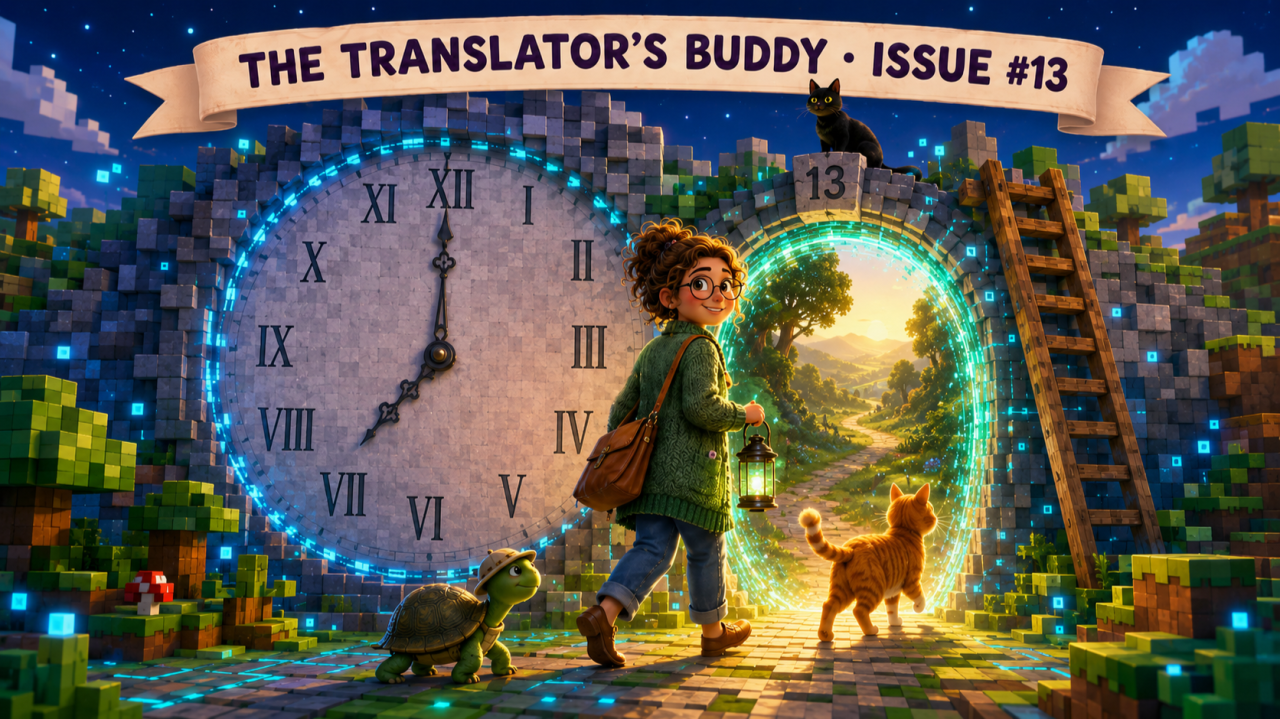
Look at a clock face. The Roman numerals run I, II, III… and stop at XII. Twelve is where our systems like to end. Twelve months, twelve zodiac signs, twelve gods on Olympus, twelve apostles, twelve in a dozen. Twelve is a complete, closed, tidy world. And 13 is simply the first number standing outside it. The trespasser. The one who crossed the border uninvited. The old stories cast the role the same way: legend counts Loki as the thirteenth guest to crash a feast in Valhalla, and tradition counts Judas as the thirteenth man at the Last Supper.
Here’s what convinced me the fear is flimsy, though. The word for it, triskaidekaphobia, only shows up in print around 1910. Friday and 13 weren’t paired as a combined menace until the nineteenth century; a stockbroker’s novel sealed the deal in 1907. And the twist a translator has to love: even the scariest name in Western culture isn’t really a name. “Lucifer” is just a common Latin noun, light-bringer, the morning star, drawn in Roman poetry as a figure carrying a torch. Later readers mistook the noun for the devil’s proper name; the horns were added by artists centuries later. By 1821 Lord Byron was writing him as a bringer of knowledge… practically a Prometheus. Punished, like the number, for stepping across a line and bringing something back.
So no, this is not the unlucky issue. This is the beyond-the-borders issue. Number 13 is where the map ends and the interesting things start. Three border crossings today:
- Beyond the border of “just a freelancer”: the paperwork that can cut your tax bill in half.
- Beyond the border of perfectionism: the phrase “good enough,” which deserves an apology.
- Beyond the border of your lonely desk: 15,000 colleagues in a secret group, and its founder, interviewed for you.
Let’s cross the first one.
🤝 The Most Boring Way to Keep More of Your Money
Twenty-five years ago I spent an afternoon on the dullest paperwork of my life. Forms. Stamps. A queue, and a registration number at the end of it.
No fireworks.
And yet, euro for euro, that boring afternoon has out-earned every client I’ve ever had.
I’m talking about making your freelance work official. Registering it as a business.
I use “incorporate” loosely, because the right form differs by country. In some places it’s a tiny one-person company. In others it’s a sole trader, a “liberal profession,” a simplified-regime entrepreneur. The label varies. The move is identical: you stop being a person who happens to get paid… and become a business that invoices.
Why does a stamp change the math? Because most of Europe quietly runs two parallel tax worlds. In one, your freelance income lands on top of your personal income and gets taxed at full progressive rates. In the other, registered small businesses get their own regimes: flat rates, automatic deductions, capped contributions. Same client, same invoice. Wildly different math.
How different? Here’s the same freelance income, taxed three ways across Europe. As a plain individual, as a registered sole trader, and what you’re allowed to write off.
| Country | Plain individual | Registered entrepreneur | Deducting expenses? |
|---|---|---|---|
| Ukraine | 18% income tax plus a 5% war levy. Twenty-three total | 5% single tax, plus a 1% war levy, plus a small fixed social contribution. Six to eight percent all-in | No expense game at all: tax is on turnover, receipts don’t matter |
| Poland | 12% up to about 28,000 euros, then 32% | Ryczałt: 8.5 to 12% of turnover for most services | On ryczałt, none needed: the low rate replaces them. Or pick the general regime and deduct real costs |
| Czechia | 15%, 23% at the top | The 60/40 regime: only 40% of income is taxed, at 15%. With social and health on top, roughly 16% all-in at 60,000 euros | 60% of income counts as expenses automatically. Zero receipts |
| Bulgaria | 10% flat | 7.5% effective. Social contributions capped | 25% of income counts as expenses automatically. No receipts asked |
| Romania | 10% flat | 10% plus capped social contributions: around 20% all-in | Real documented costs, or a simplified turnover-based option |
| Italy | 23 to 43% progressive, plus regional and municipal add-ons | Forfettario: 15% on 78% of turnover, so about 12% of gross. New businesses: about 4% for the first five years | None needed: 22% is assumed automatically. No VAT, one simplified return. Translation is on the eligible list |
| France | Progressive up to 45%, plus heavy social charges. Around half, all told | Micro-entrepreneur: about 28% of turnover all-in, under 77,700 euros. Radically simple | None: a built-in allowance replaces receipts. No VAT, one revenue log |
A disclaimer, and an invitation. I compiled this from open sources in July 2026, and tax tables age like milk. If your country’s row looks off, or your country is missing entirely, leave a comment and set me straight. Corrections from people who actually pay these taxes beat any website. That’s how the reader’s map gets built.
Every country in that table built a second world on purpose: register your one-person business and you drop into a flat, low, simple deal, usually with expenses assumed automatically, no shoebox of receipts required. How’s your country doing?
And the countries you don’t see in the table? They’re absent for a reason. In Germany, Belgium, Spain and the Netherlands, a registered sole trader pays the same personal rates as everybody else. No special regime exists, and the Dutch are actively phasing out what little relief there was. Hungary technically has a simplified scheme, but its famous KATA was closed in 2022 to anyone who invoices companies, which is to say, closed to translators. My colleagues in those countries, you have my respect and my sympathy. There, the deduction game is the main game, and the only real door out is a proper limited company, a heavier tool whose payoff is a calculation, never a slogan.
Either way, the map points one direction. Across the EU, registering as a sole trader either drops you into a lighter regime or, at worst, opens deductions you didn’t have before. Not once does it make things worse. The unregistered translator quietly pays the worst rate available in her country, while her registered neighbor, doing identical work, keeps the difference. The only question is which flavor of “official” your country rewards.
Two things the table can’t show, before we go on.
First, liability. In most of Europe, a sole trader answers for business debts with everything he owns, right down to the apartment. France is the rare exception: since a 2022 reform, a French sole trader’s personal assets are automatically walled off from business creditors. Everywhere else, that wall is called a limited company, and it costs extra paperwork and accounting.
Second, deductions. A registered business writes off its CAT tool, its laptop, part of the home office, that conference in Warsaw. Remember the refurbished ThinkPads from issue #1? Registered businesses reclaimed the VAT on them. Everyone else just paid it. And registration changes how direct clients read you: a business with an invoice and a number looks like a supplier, a person with a bank account looks like a risk.
And if the words invoices and paperwork make you flinch, that’s the whole point of a tool like Translation Office 3000: it keeps the boring half of the business, who owes you what, paid when, spent where, quietly in order. That matters more every month, because Europe is switching to e-invoicing. A real e-invoice is a structured, machine-readable file sent through an official network, and a plain PDF emailed across won’t count. Belgium already made it mandatory this January, over the Peppol network. Poland went live this spring, France follows on September 1, Germany through 2027 and 2028, and the whole EU by 2030. The direction is one-way. TO3000 already handles structured e-invoices in Italy, Germany and beyond, and we’re working to make it available in as many markets as possible. Any orderly system beats a folder of Word files. That one just happens to be ours.
✅ This week. Find out what the small-business regime in your country actually costs, next to what you pay now. Then leave a comment and tell me how it works where you live. One line is plenty. If enough answers come in, I’ll build a reader’s map of freelance regimes across Europe.
Same client. Same invoice. The only variable is the stamp on your paperwork.
⚡ Good Enough Is a Skill
Right before the AI wave hit, our conferences were already full of project managers using two words that made purists wince: “good enough.” Good enough translation, they meant, for material that doesn’t need to be perfect. The room would bristle. But they were onto something a Nobel laureate had figured out decades earlier.
In 1956, an economist named Herbert Simon noticed something heretical about how people decide. Classical theory said we weigh every option and pick the very best one. Real humans? We pick the first option that clears the bar… and get on with our lives. Simon glued satisfy and suffice together and called it “satisficing.” The Nobel committee liked the heresy enough to hand him the prize in 1978.
Now look at where translators do the exact opposite. And pay for it by the hour.
A client sends five hundred product descriptions for an online shop. Shoppers will skim them for a size and a price and click away. And we translate them like each one is going to be carved into a courthouse wall. Three full passes. Synonym agonizing. A comma moved at midnight and moved back at breakfast.
The client ordered a bicycle. We hand-built a Bentley. And the meter ran on our own unpaid hours the whole time.
Nobody tells you this at translation school: there is no single thing called quality. There are four different bars, and each one is a different job:
- The gist. Someone just needs to know what a document says. Rough is fine, fast matters, and let’s be honest, in 2026 the machine does this one on its own. You are not needed here, and that’s fine.
- The workhorse. Those five hundred shop descriptions. Clean, accurate, nobody frames them on a wall. Light post-editing of a machine draft (MTPE) is usually enough, and pricing that honestly keeps you competitive.
- The showpiece. Marketing copy, a website headline, anything public and proud. This one has to sing, and the machine still can’t. Polish away.
- The bulletproof. Contracts, patient leaflets, safety manuals. Maximum rigor, a second pair of eyes, no shortcuts. Ever. This is where a human name on the work is the whole point.
The craft: knowing which bar this job must clear, and clearing it cleanly. Notice which way the bars are moving, too. The machine is rising through the bottom two. Your value is climbing to the top two, where a human still has to answer for the words.
So before you translate a word, ask the client one question: “Who will read this, and what happens if it’s slightly imperfect?”
That single question sorts almost every job into its bar. It also quietly upgrades your reputation. Clients never experience your inner perfectionism. They experience whether the thing showed up on time and did its job.
One guardrail, before anyone quotes me out of context. The floor never moves: names right, numbers right, meaning right, nothing skipped. True for the shop descriptions. True for the courthouse wall. What moves is everything above the floor: the third pass, the hour lost between two fine synonyms, the formatting nobody asked for. Spend that hour where the purpose demands it. Take it back where it doesn’t.
Voltaire, quoting an old Italian proverb, compressed this whole block into one line: the best is the enemy of the good. He wrote that in the 1770s. We’ve been paying for the mistake by the hour ever since.
✅ This week. On your next job, ask the purpose question before you start. Agree the answer with the client, in writing if you can. Then match your passes to the bar… and notice how much time walks back into your day.
🧠 You Are Never Alone in This. The Founder of a Secret Translator Group Explains.
Since this is the beyond-the-borders issue, I went beyond mine: I brought you an interview.
There’s a closed Facebook group where more than 15,000 translators say the things they could never say to a client’s face. It’s called Things Translators Never Say, TTNS for short. And for this issue, its founder, Erik Hansson, a Swedish technical translator living in Germany, told me how a secret society of our profession gets born. Condensed slightly, with his blessing.
How did it start?
“It was one of those days back in 2013 when another potential client had offered me an insulting rate. That was the spark. Most freelance translators work alone and have no direct colleagues around to turn to when they need to let off steam. Family and friends outside the profession simply can’t understand our daily issues with potential clients, late payments or insulting enquiries.
So the idea came: a closed group where we can exchange experiences and let off steam rather than just moan, without putting our business relationships with clients at risk. It didn’t take long to realize that even if we come from different countries and cultures, we all struggle with the same problems.
In August 2013 I set up Things Translators Never Say. It has grown steadily ever since, and now has well over 15,000 members from all over the world.”
The idea, he’s quick to add, was always bigger than moaning.
“I wanted a platform to exchange ideas, strengthen your self-confidence, and move beyond isolation. And let’s not forget how useful irony, sarcasm and tongue-in-cheek can be when dealing with annoying situations.”
Why is it so popular?
“It became far more than a place to vent. Members share practical information for beginners and seasoned colleagues alike: how to deal with payment issues, what to expect from a new agency, how to negotiate with more confidence. So TTNS also has an educational value.
But the main reason people come is the light-hearted atmosphere and the feeling of being part of a big community of colleagues. We work with different clients in different cultures, and still share the same daily situations.”
How do I join?
“If you’re a freelance translator or interpreter, you’re very welcome. Go to facebook.com/groups/thingstranslatorsneversay and apply. Answer the questions in the admittance process, and our admin team will be happy to open the gates for you.”
Notice what Erik actually built, though. Not a complaints department. A border crossing. On one side, you and a bad rate offer, alone at your desk at 11 p.m. On the other side, fifteen thousand people who’ve seen that exact email, know what it’s worth, and will have you laughing about it by morning.
The membership fee is a couple of honest answers in the admittance process. The return is the quiet upgrade from “me against the inbox” to “us, comparing notes.” And a place where your worst client story is, at last, fully appreciated.
Erik built his group because a bad rate offer found him alone at his desk. Thirteen years later, nobody who joins has to be alone for the next one. This profession looks like thousands of people working solo. Connected, it runs more like one very large office… with excellent gossip.
✅ This week. Apply to join TTNS. Then, once the gates open, do one small thing: post a hello, or answer one question from a newer colleague. Communities run on exactly that. And you’ll never again read an insulting offer completely alone.
If one of these three landed, leave a comment and tell me which. I read every single one. This week I’m extra curious about the tax replies… the reader’s map depends on them.
Thirteen turned out fine, by the way. The view past the border is better.
P.S. You’ve already heard about this one from me, but I’d really like a win-win here before it’s gone. Twenty-five years of tools, all in one place: the AIT Unlimited Club. One license, yours for life, no subscriptions, everything we make now and everything still to come. Cross the border and become unlimited today. You’ll also help us speed up building the next tools, which is the best kind of thank-you we could ask for.
Have a great and rewarding week.
Sincerely yours beyond borders,
Volodymyr
and the AIT Software Development team