Not once. Six years. He fixed a cracked molar at 9 PM on a Sunday, for free — I still don’t know how he picked up the phone. He’s brilliant. I’d happily tell every person I know. 🦷
But he never asked. So I never did.
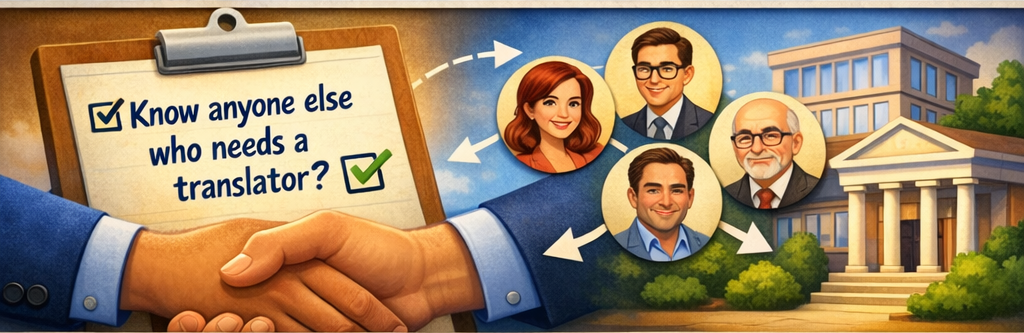
Turns out this is not just my dentist’s problem. A Texas Tech University study found that 83% of satisfied customers are willing to refer a business — but only 29% actually do.
Fifty-four percentage points of goodwill, just sitting there. Doing nothing. Because nobody thought to say “do you know someone who might need this too?”
That’s topic one today. Topic two is about word counts — I dug into the memoQ vs. Trados differences and some of the results are just absurd. And topic three: I went down a rabbit hole on the 20-20-20 eye rule and discovered the guy who invented it never meant it as medical advice.
🤝 The Referral Thing Nobody Does
I’ll be honest — I used to think “asking for referrals” sounded desperate. Then I looked at the data: 84% of B2B decision-makers start buying with a referral (Influitive). Referred customers have 16% higher lifetime value, 37% higher retention (Wharton School). Yet only 30% of B2B companies have any formalized referral process.
In translation? I’d guess 5%. Maybe less.
What actually works (without feeling gross):
Do something worth mentioning. I’ve had translators send notes with delivery: “Paragraph 3 has a date that contradicts paragraph 7. Might be a typo in the original.” Two minutes of care. I remembered that name for years.
Ask at the peak. Right after “this is great, thank you” — not three months later. Words: “If you know another PM who handles [legal/medical/marketing], I’d love a quick intro.”
Do the work for them. Write the intro email yourself. Two sentences. They just forward it.
Thank them like a human. Not with a gift card — that turns it into a transaction. A LinkedIn shout-out. A handwritten note on paper (people are visibly confused when they get mail that isn’t a bill). A Christmas card with local chocolates. The point: they feel appreciated, and two years later your name comes up before anyone finishes the question. 🎁
91% of customers would give referrals, but only 11% of salespeople ask (Heinz Marketing). Your whole marketing strategy might just be: start asking.
Quick math
10 clients. One ask per quarter. 20% hit rate = 8 new clients/year. Zero ad spend. Zero ProZ fees.
🔢 Word Counts Lie
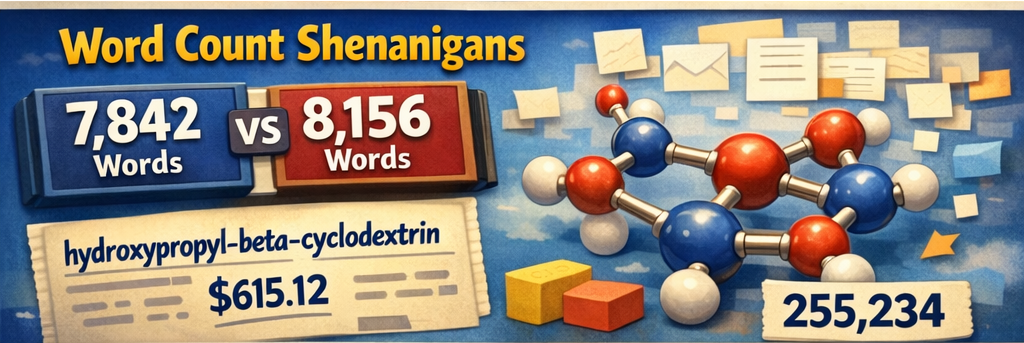
Took a 15-page technical manual last week. Ran it through four tools. Same file. Four different counts. Spread: ~4%. At €0.12/word, that’s €23 per document. 200 projects/year? Over €4,600 nobody noticed.
Examples that will ruin your day
Pharma compounds. “hydroxypropyl-beta-cyclodextrin” — 1 word in memoQ native mode. 3 words in Trados-like mode. Same tool, same file, same screen. (memoQ Help Center.) Picture a 10,000-word pharma manual. 💊
Numbers that vanish. “255,234” — memoQ counts it. Old Trados Workbench doesn’t. Trados Studio reversed course and counts again. Upgrade your Trados version, count goes up. Nobody touched the source.
The dollar sign. “$615.12” — 1 word in Word. 2 in Google Docs. A reference like “DIN 2137-1:2018-11” — Trados splits every piece around the slashes.
Numbered list trap. Word’s auto-numbering? Trados Studio excludes it from count. Typed “1.” manually? Counts as a word. Same list. Different invoice. (Paul Filkin, multifarious.filkin.com, 2012.)
Hyperlinks. Studio: URL = 1 placeable. Old Workbench: splits at colons/slashes = multiple words. .DOC vs .DOCX of same file? Different count.
Text boxes. Word ignores them. memoQ imports and counts everything inside. HTML file in Word vs same HTML in memoQ: dramatically different totals.
.DOCX vs .RTF of same file. Import both into memoQ. Different counts. Different import filters. I checked twice.
The RWS Community’s top reply to a thread on reconciling memoQ and Trados counts: “This is comparing apples and oranges. There is nothing you can do about it.”
What to do: (1) Agree on counting tool before you quote — put it in your T&Cs. (2) Count the source, not the target. (3) For one number you can trust across 40+ formats — tagged PDFs, InDesign, XLIFF, Visio — that’s what we built AnyCount for.
👁 The 20-20-20 Rule Is Not What You Think
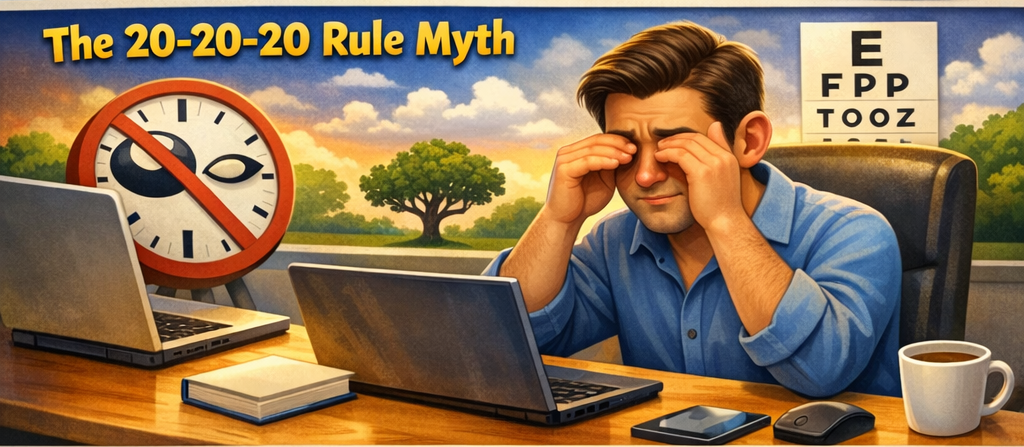
I always assumed the rule was based on some solid clinical trial. It was invented for a TV interview.
California optometrist Jeff Anshel coined it during TV appearances in the 1990s. He needed a soundbite. The numbers came from adapting musculoskeletal (not eye) break research. Brian Chou tracked the origin for Optometry Times and concluded: the rule became famous for being famous. No study validated it before it went viral.
Then someone tested it
Johnson & Rosenfield (2023, Optometry and Vision Science, SUNY): 30 participants, 40-min tablet task, breaks every 5/10/20 min or none. Result: no significant difference. 20-second breaks didn’t help more than doing nothing.
Rosenfield, PhD: “We didn’t rule out that breaks help. We found that 20-second breaks every 20 minutes were ineffective. Breaks need to be longer — perhaps 1 or 2 minutes.”
A 2022 study (Talens-Estarelles et al.) found dry eye symptoms improved with software reminders — but vanished one week after reminders stopped.
What I actually changed
5-min break every hour. Galinsky et al. (2000, Ergonomics): 30-min work / 5-min rest minimized eye strain. Pucker OD, PhD recommends the same, based on myopia research. AOA says 15 min every 2 hours. I set a phone timer. Annoying. Works.
Blinking on purpose. Sounds dumb. But: blink rate drops 56% on screen (Tsubota & Nakamori, 1993). And 7% of on-screen blinks are incomplete — lid doesn’t fully close (Portello et al., 2013). I close eyes firmly 10 times during breaks. Feels stupid. Eyes feel better.
Monitor lower. AOA: screen center 10-13 cm below eye level. Down-gaze reduces exposed eye surface, slows tear evaporation (Argilés et al., 2015). Mine was too high for years.
Threw out blue light glasses. 2023 Cochrane review (17 RCTs, 619 people): no benefit vs. regular lenses. AAO position (2024): no evidence. UK Ad Standards Authority (2015): marketing them as filtering “harmful” light is misleading. Both my pairs are in a drawer. 🤓
€20 humidifier. TFOS DEWS II Report (2017): humidity is a recognized dry eye factor. Office AC pushes it to 20-30%. Eyes want 40-60%. Done more for me than two years of eye drops.
Annual eye exam. Meta-analysis (103 studies, 66,577 people): 66% of screen users have DES, rose to 80-94% during COVID. Many of us wear distance prescriptions — but your screen is at 50-70 cm. Half a diopter off = your 4 PM headache.
The 20-20-20 rule isn’t wrong. It’s a ’90s TV soundbite nobody bothered to update. Take real breaks, blink like you mean it, fix your desk, see your eye doctor. Less catchy. Actually works.
📚 For the curious
Referrals: “The Referral Engine” by John Jantsch (2010).
Word counts: Paul Filkin’s “So how many words do you think it is?” on multifarious.filkin.com. And our AnyCount docs.
Oh, and remember my dentist from the opening? Turns out he might be protecting my eyesight too. A 26-year study of ~40,000 men (Dr. Louis Pasquale, Journal of Glaucoma) found gum disease with tooth loss increased glaucoma risk by 86%. Bacteria from oral infections travel through the bloodstream and damage the optic nerve. So maybe I should go recommend my dentist after all. 🦷
Until next week,
Volodymyr & the AIT Software Development team
Got a question — technical, business, or just something that’s been bugging you about this industry? Hit reply. Best ones become the next issue. 💬
Join The Translator’s Buddy — a practical bulletin packed with real tips, proven workflows, and hands-on solutions for translators and translation business owners.
Just actionable insights you can use right away to improve productivity, quality, and profit.
Subscribe now and get smarter with every issue.
Also get notified about our special offers and news.