|
The Translator’s Buddy · Issue #14 · 4 August 2026 · ISO Week #32
Rates, Fates, and Life Beyond Translation
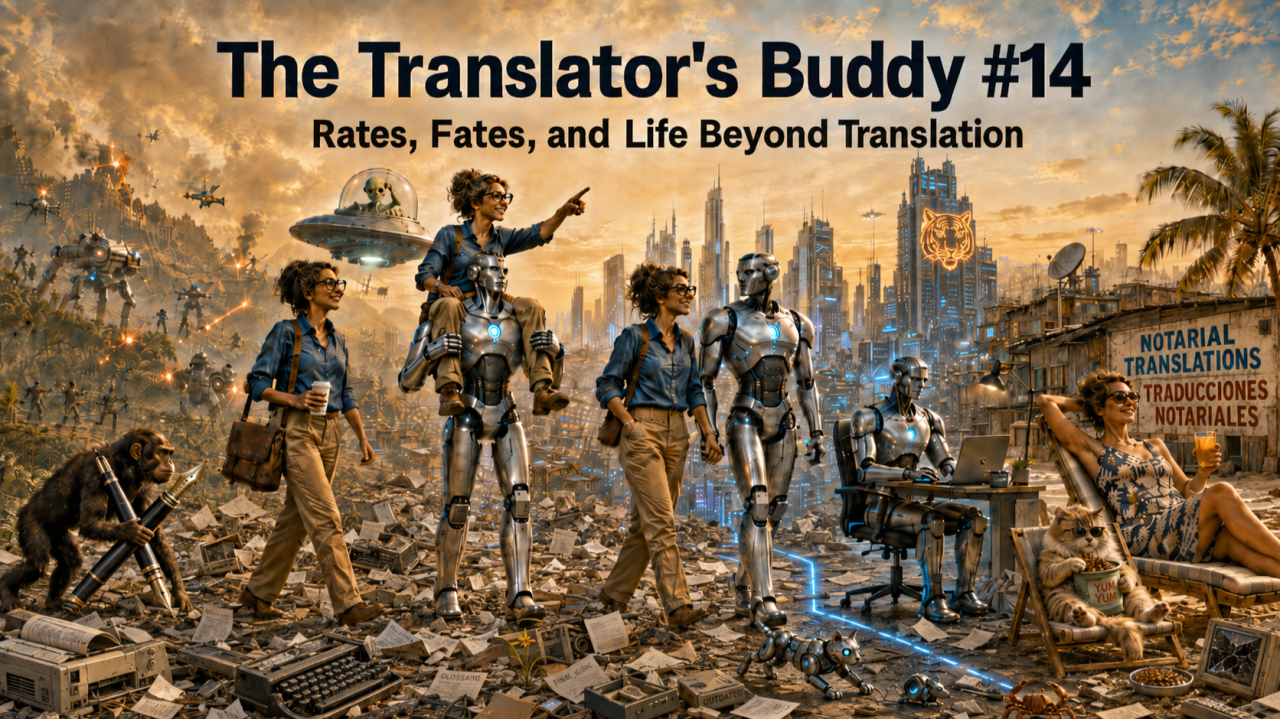
Is 2026 the first time a machine has walked into a text profession? It is not. By my count, it is at least the third.
When Gutenberg’s press spread across Europe, the first people it hurt were the copyists, professionals who earned their living copying books by hand, letter by letter. The greatest text worker of the age, Erasmus of Rotterdam, did not fight the machine: in 1508 he moved into the Venice print shop of Aldus Manutius and expanded his book of proverbs while the pages were being set. The hand-copying workshops died out, but the people of the text walked into the print shops, which ended up employing more of them than copying ever had.
When AT&T replaced its switchboard operators with mechanical exchanges between 1920 and 1940, economists later traced the women in the records, person by person (Feigenbaum and Gross, Quarterly Journal of Economics, 2024). The operators at the boards on the day of the switch lost out, but the next cohort of young women found other work, often better paid, and the damage landed on those who stood still.
And in the 1950s, NASA employed rooms of people whose job title was “computer”. They calculated flight trajectories by hand, and if you have seen the film Hidden Figures, you already know one of them: Dorothy Vaughan, the mathematician played by Octavia Spencer. When the electronic kind of computer arrived, the real Vaughan did not wait for it to take her desk. She learned FORTRAN before most of the engineers, taught her whole team, and moved with them into programming the very machine that was meant to replace them. She did not stop being a mathematician for a single day.
Each time the instrument changed, the people who picked it up carried their trade forward. The title alone protected nobody, and the pattern has always favored the ones who kept moving.
Now the machine has walked into ours. People call it the fate of the profession, and I would be careful with that word. Sailors in the Strait of Messina used to see castles floating above the water and named them Fata Morgana, after the sorceress who built them out of thin air. Half of what gets called fate in our industry is that kind of castle, and the rest is a person deciding what to do next.
So this issue is about the deciding: the life before translation, the hours inside it, and the life after it.
Meanwhile, we have brought back our Unlimited offer for one week, at unlimited.translation3000.com, with the details at the end of this letter.
🤝 Make Money: The Two-Way Door
In March, the European language industry published its annual self-portrait, the ELIS survey: 1,058 answers across 45 countries, and the gloomiest mood on record. Rates fell in 2025, nobody expects them to rise in 2026, fewer than half of the freelancers surveyed still believe freelancing is a viable long-term career, and a year earlier 23 percent of independents said they were thinking about leaving.
Yet one number refuses to match the mood: one in four raised prices in 2025, while only 12 percent cut them. After thirty years of selling software to both groups, I can tell you the difference is rarely talent, because talent in this profession is abundant. The difference is what surrounds the talent.
The other 63 percent held their rates steady. Here is what “steady” has meant over the past ten years, while consumer prices rose:
| European Union |
+33% |
| United States |
+36% |
| Canada |
+28% |
Eurostat, HICP 2016-2025. US Bureau of Labor Statistics, CPI 2015-2025. Statistics Canada, CPI 2015-2025.
Those are averages. If you work from Hungary, Romania or Estonia, your local numbers are 73, 62 and 61 percent.
Now do the maths with me. If you charged €0.10 per word in 2015 and still charge €0.10 today, that rate buys what €0.075 bought back then. It amounts to a pay cut of roughly a quarter, delivered in small yearly slices, and nobody even negotiated it with you. The supermarket collected the difference. The same €0.10 needs to be €0.13 today just to stand still.
So the quarter who raised prices did nothing heroic. They stayed level. And that is the most encouraging number in the whole survey: catching up is not audacity, it is maintenance, and a quarter of your colleagues have already proved the market accepts it.
What else does that quarter know?
One more number before the useful part. The Middlebury Institute in Monterey, founded in 1955, trained localization managers for Netflix, Google and Salesforce, and was the only school in the United States with a UN agreement to train UN language staff. This year it took its last students, and all programs close by the summer of 2027. Officially it was a financial decision, after years of falling enrollment.
Read that again: the students stopped coming before the school stopped teaching. They looked at a translation degree and chose a different door.
The old entrance is narrowing, and the side doors are where the movement is.
Door in: your past life is your moat.
The machine eats general text first, and it has nothing to do with difficulty. Mistakes there are simply cheap, because nobody dies if a lifestyle blog reads flat. Now price a mistake in a dosage instruction, a patent claim, or a merger agreement. Where errors cost the whole business, buyers still pay for a human who has seen the subject from the inside.
Agencies already price this. A translator who spent years in a courtroom, a lab, or a hospital quotes different numbers than a colleague with the same language pair and a general CV, because the client is buying two careers at once, and very few people on earth can sell that combination.
So ask yourself two questions, in this order: what did I do before translation, and who is terrified of getting that subject wrong? Army service counts, and so does a pharmacy counter, a law office, or a childhood spent fixing cars with your father.
Door out: your skills travel further than you think.
After many years of freelancing you already are, without noticing, a project manager, a terminologist, a quality auditor, and a one-person client service department. The market has names and salaries for these people: localization project manager, language lead, language data specialist, AI output evaluator. One street further out, the same skills carry into project management, international sales, customer success, and market-entry consulting, where the work holds because a human is trusted, present, and accountable. Every one of those doors is real, and some of you may want to try one this year.
But let me say what the people selling those doors will not. Most of you did not fall into translation by accident. You chose it, and given the choice, you would rather stay in it, if staying paid. So the rest of this section is about the door nobody advertises.
The third door: stay, and run leaner.
Two levers decide what an hour of your working life actually earns.
The first is the routine around the work. Count what surrounded your last project: the quote, the follow-up, the invoice, the reminder about the invoice, the file conversion, the bookkeeping entry. None of it is billable, and all of it comes out of your evenings. Every hour of routine you remove is a rate increase nobody has to approve.
The second is the speed of the core work itself. The same machine that pressures your rates from the outside is also the strongest instrument a translator’s desk has ever seen, and nearly two thirds of freelancers already use it in some form. The question that decides your next five years is whether it sits between you and the client, or in your hand.
That is the Erasmus move from the top of this letter, and the Dorothy Vaughan move: change the instrument, keep the trade, keep moving. Hollywood made a film about her for a reason.
So here is our part in this, and let me start with what it is not. Nobody at AIT is going to promise to requalify you into an automation consultant. You will get a hundred of those promises this year, mostly from people who have never invoiced a translation client. Our promise is narrower, and we have been keeping the first half of it since 1996: we take the administrative routine off your desk. Quotes that assemble themselves, invoices that track themselves, client history that stops living in your head. Every hour of routine our tools remove is that raise nobody has to approve, arriving on its own.
The second half of the promise is new, and it is in production now: AI-first tools for the translation work itself, so the billable hours produce more too.
If you want both halves handled, the details and a date that matters are at the end of this letter.
Every door in this section is real and open, and walking through one is the part nobody can automate.
Three things to do this week.
First, write down every job, industry and obsession you touched before translation. That list is your niche inventory, and most people have never put it on paper.
Second, sort last year’s income by subject field and find which domain pays you most per hour of your life. Prepare to be surprised.
Third, for one week, count the unpaid hours around your projects, the quoting, invoicing, chasing and converting. Every hour you remove from that list is a raise nobody has to approve.
The machine has learned the words, but it has not lived your life.
⚡ Work Faster: The File That Would Not Open
Here is a scene every translator knows. A client sends a 340 MB translation memory export, Windows Notepad thinks about it for ninety seconds and gives up, and all you needed was one string changed, because the client renamed the product.
Download Notepad++ (notepad-plus-plus.org) and the same file opens in about four seconds.
Don Ho released the first version in November 2003. It is free, open source, Windows only, and weighs roughly 4 MB, and two decades on I still open it more often than anything I ever paid for. Here is where it earns its place.
1. The file nobody else will open. Huge TMX exports, terminology dumps, CAT tool logs. The standard editor dies, and this one opens them.
2. Find and Replace across 200 files. Find in Files searches a whole folder tree and replaces in every match. When a client renames a product across an entire project on a Friday afternoon, that is two minutes of work instead of an evening.
3. Broken characters. That CSV or SRT where your text arrived as “привіт”. Go to Encoding, choose Convert to UTF-8, save, and the file comes back to life. This one trick has rescued more of my Fridays than I can count.
4. Tags that will not validate. XLIFF and TMX are XML underneath, so when your CAT tool refuses a file and points at a line number, syntax highlighting shows the mismatched tag immediately.
5. Two versions, one truth. The Compare plugin puts two files side by side and highlights every difference, which settles the question of the newer export in ninety seconds instead of an argument with yourself.
6. The portable version. Unzip it to a USB stick and run it on a locked-down client machine where nothing can be installed.
One serious warning: make a copy first, every time. Hand-editing a TMX or an SDLXLIFF breaks it quickly and quietly, and the damage shows up three days later in a different file. Copy, edit the copy, test, then replace.
On macOS the equivalents are BBEdit, Sublime Text, or VS Code. They are slower at this particular job, but they do it.
Four megabytes, no license fee, and more deadlines saved than by anything I have ever bought. Forward motion sometimes weighs very little.
🧠 Stay Sharp: Life Beyond Translation
You are a translator. Fine, but what else are you?
I ask because translators tend to introduce themselves with their job and then stop, as if the rest were a hobby, or an embarrassment, or nothing. So I will go first.
I never planned to work with languages. I trained in cybernetics at a technical college. Then Ukraine became independent, and in 1992 a university that had been closed for 175 years opened its doors again in Kyiv. The Kyiv-Mohyla Academy took back its own buildings on Kontraktova Square, which the Soviet navy had occupied since 1967 as its only school for political officers. The military left slowly, floor by floor, over four years, and I watched them tear the fittings out of the walls on the way out. The first room the university got back, its founder won from the admiral in a game of chess.
I studied political science and economics in the rooms where they had taught scientific communism. To pay the tuition, I built practice tests for Raymond Murphy’s English Grammar in Use for the English department, and that was the first money anyone ever paid me for anything to do with language. From there I started freelancing for translation agencies, and two years later I had more work than I could physically do, so I started an agency. That is how a cybernetics student ends up spending thirty years in translation.
Now the part I do not usually mention. In 2007 I enrolled in television directing at the Karpenko-Kary university in Kyiv. I finished in 2013, and then came the revolution, the war, covid, and the full-scale invasion. Thirteen years later I still have not made anything beyond my student work. I have not dropped it, though. It is waiting behind one more release cycle, and it has been waiting behind one more release cycle for a while now, and I know exactly how that sounds.
Here is why I am telling you this. Every translator has three lives: the one before translation, which quietly funds your specialization today, the one running alongside the work, and the one after, which almost nobody plans, because nobody hands a freelancer a retirement date.
The first life is the one you undervalue most. A translator who spent a few years on hospital wards and now handles clinical documents, a former bank clerk who translates loan agreements, a onetime service engineer who translates the same kind of manuals he once worked from: the market calls them double specialists and pays accordingly, because it took years to master the languages and years to learn the field, and very few people hold both.
That is my answer to the question this section opened with. Yours is worth writing down some evening, even if nobody sees it but you. Three lives is not a burden, it is momentum: proof that you have reinvented yourself before, and can do it again.
That is the whole issue. I hope it gave you a clearer picture of where the industry stands, and a trick or two you can use this week.
One optional step remains, if you have not taken it yet. This week the AIT Unlimited Club is at its widest: join by Sunday, 9 August, and one payment covers every AIT product we have ever made and everything we release next, desktop and web, including the AI-first line now in production, and the Starter Package of A-Databases, soon to be released (application data for 1,000 translation agencies around the world). From Monday, 10 August, new Unlimited licenses will cover desktop products only. Already a member? Then you are covered, and you will get an email from me the day the first of the new tools ships.
See what is included at unlimited.translation3000.com. It is no magic pill, but it will help you stay afloat for the next three to five years and plan your further steps with a clear head.
A few readers have written that I keep quoting the same three books, which is fair, so let me close with a football coach instead. In 1959, Vince Lombardi took over a team that had won a single game the previous season and built it into a five-time champion. His line is the one I keep coming back to:
“The difference between a successful person and others is not a lack of strength, not a lack of knowledge, but rather in a lack of will.”
Whatever this year does to our industry, the winning move has not changed since Erasmus walked into that print shop: keep moving forward.
Have a great rest of the summer. I will keep you posted on our developments, and I read every reply to this email.
With kindest regards,
Volodymyr.
|